Penn Medicine Pavilion Case Study

The University of Pennsylvania Health System is a major multi-hospital health system headquartered in Philadelphia, Pennsylvania. UPHS and the Perelman School of Medicine at the University of Pennsylvania together comprise Penn Medicine, a clinical and research entity of the University of Pennsylvania.
The Pavilion’s Design
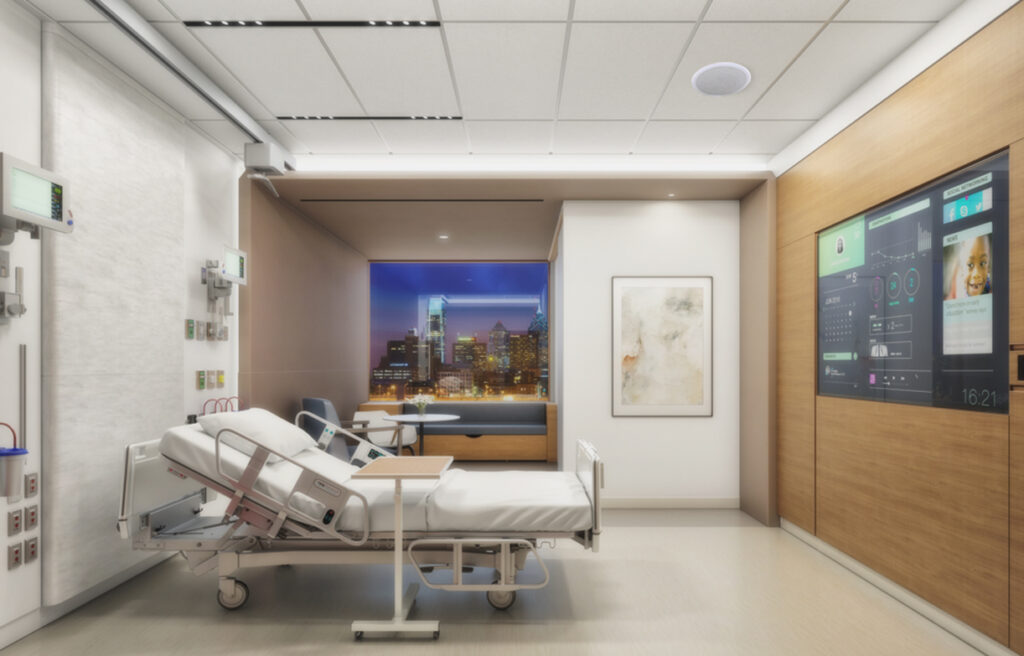
The Pavilion was one of the largest hospital projects in the United States and the largest capital project in the University of Pennsylvania’s history. The building itself is a massive 1.5-million-square-foot, 17-story facility with 504 private patient rooms and 47 operating rooms. However, what makes it so unique is its design, which centers entirely around patient care.
The design relies on the expertise of Penn Medicine’s own clinical experts as well as architecture, design, and construction professionals who specialize in health care. This group of experts was known as the “PennFirst” Team. The end result is a culmination of years of meticulous thought, collaboration, and research about how to organize clinical care spaces to be effective for both clinicians’ and patients’ needs.
Selecting QSC’s Public Address System
Penn Medicine has been a customer of Symtech’s for over 10 years. Starting with the QSC Public Address System in the University of Pennsylvania Hospital in 2006. This original and new public address system connects all of Penn Medicine’s Philadelphia Hospitals to one centralized command center. When an announcement is made from the command center, the “verified paging” feature records the call and plays it back to verify the correct message was delivered. The command center also takes priority and can manually override other announcements during an emergency.
The PennFirst Team sought to standardize this design in the new Pavilion to make one cohesive system throughout the Penn Medicine Network.

Designing the Public Address System
Symtech’s Public Address System allows the new Pavilion to transmit notifications of both code color, plain language, and instructional information to staff, patients, and visitors in times of medical and security emergencies, as well as disaster response.
Paging stations are placed throughout the facility and Notifications can be sent facility wide or to individual zones as needed. Announcements can be made to specific units, by floor or throughout the entire campus. In addition, pre-recorded messages can be triggered during an emergency to expedite a clear response.
Installing the Public Address System
Symtech’s technicians worked closely with Philadelphia Union Contractors and Penn Medicine project managers to complete the installation of the public address system in 4 weeks. Symtech technicians programmed the headend equipment, devices, tested, and certified the system. They also provided maintenance and user training to staff.
Ongoing Support and Maintenance
Symtech Solutions provides 24/7 onsite and remote service to maintain and troubleshoot any technical issues that may arise, support programming changes, system upgrades or expansions.
Symtech will provide an annual system inspection and recertification to test the system and assure it is up to spec. Technicians perform a visual inspection of all components, cabling and connections, clean system components, check battery condition, replace speakers, check event timers, digital announcements and other control circuits for proper operation.
Results & Future Plans
The Penn Pavilion opened in October 2021 and has transferred most of emergency services from the University of Pennsylvania Hospital to the new Pavilion.
The head end components of the public address system can be leveraged system wide for reduced future integration costs. The QSC public address system will allow Penn to expand the system in the future shall they add more buildings or want to add panic buttons, text/email alerts or other features.